

The Role of Mercedes Ambulances in the Healthcare Sector: A Comprehensive Study
1. Introduction to Mercedes Ambulances
Mercedes Ambulances; Mercedes is one of the world’s most trustworthy automakers. They are known for their high-end vehicles, which have luxurious features. However, Mercedes is not only about making types of machinery that are of top quality. They are also concerned about innovation and are always precise about substantial work. They are ahead in producing innovative goods or services that attract the attention of the people automatically.
Mercedes has also made its place among the best ambulance producers. For a long time, Mercedes has provided the world with various kinds of ambulances that are a combination of luxury and advanced features. Mercedes has been actively contributing to this sector.
There are some pieces of research that are directed to give an understanding of how advantageous these ambulances can be in healthcare sectors. In large countries, the necessity for emergency medical amenities is increasing day by day to meet critical needs. So, numerous countries use these vehicles, fully equipped with powerful engines, to reduce the time it takes for patients to reach the hospitals.
1.1. History and Evolution
Before paramedics and emergency services began using ambulances, a standard vehicle would be used for conveying the sick and injured to hospitals. The refinement and conversion of vehicles led to the creation of a dedicated emergency vehicle. Following World War II, Mercedes gradually began to develop a vehicle that would meet the demands of an ambulance as closely as possible. In an increasingly independent age of medical aid provided by private physicians and larger ambulances powered by more powerful engines, many German states also converted standard vehicles from the 1950s. The first post-war ambulance from Mercedes based on existing models dates back to the early 1930s, while the first in-house production was launched in the early 1950s.
Several vehicles of the type L 319 were built as transport vehicles for the injured and can be used for doctor visits as well as for internal use by the fire brigade. The “medical attachment” can also be used for optional longer use, just like the image vehicle for general medical inspection. Emergency medical aid was the domain of a vehicle fleet capable of rapid, flexible, and reliable deployment under the guidance of headquarters, with a suitable application area and access road to the central accident reception area. Cooperation with public safety agencies and emergency services continued to be promoted. Various technological and medical advances and developments also made the design of emergency vehicles adapt to the current situation and, in some cases, de-escalate. Ongoing discussions were held on the design and creation of Mercedes ambulances in order to further develop the emergency and medical services being carried out. Many participants made efforts to upgrade to the future of information technology, guidelines, and equipment for reliable, quick, and often standard deployment of independent regional structures. Thus, suggestions for the ambitious goal of “similar medical care on the spot” began: the first series of ambulances with special vehicles in the 1960s and 1970s underpinned the concept, promoting the transfer of the patient’s medical record with a standardized one-time card and introducing an automatic defibrillator. In parallel, an emergency aid center was set up for the first time with a limited level of qualification and new communication options.
2. The Importance of Ambulances in Healthcare
In the modern world, ambulances are a vital part of healthcare that assists medical professionals in meeting the changing demands of the healthcare system. In the event of an emergency, time is of the essence for the swift transportation of persons from one area to another. Lives can be saved or injuries minimized with the quick availability of excellent pre-hospital and newly updated healthcare. In any emergency healthcare system, early detection and prompt action will assist the medical staff in identifying and managing victims’ treatment requirements. Regular ambulances should have the appropriate gear and machinery to care for critically ill patients. The advancement of the medical field has necessitated the use of basic and advanced lifesaving technology. It is also common knowledge today that rapid response systems have a substantial impact on the efficient and appropriate care of unresponsive and emotionally volatile patients.
In the field of pre-hospital healthcare services, transportation times are most likely to lessen the likelihood of patients living with ST-segment elevation myocardial infarction. Trained personnel should ride in an emergency vehicle for urgent healthcare, depending on the patients’ needs. The pre-hospital surroundings, as well as the smooth functioning of an ambulance, reveal the importance of an organized pre-hospital healthcare system because the health of a community is primarily contingent on whether ambulance services are provided when required. Despite the substantial investment in ambulances, a lack of valuable systematic studies on the resource allocation of ambulance service systems has emerged. Ambulance service systems with robust hierarchical construction not only have advantages in real-time logistics operations but also have general advantages. Warm-up time as well as response time for emergency service, and particularly for ambulance services, is assessed to enhance the healthcare system.
2.1. Role in Emergency Medical Services
2.1. Role in Emergency Medical Services.
Emergency Medical Services (EMS) in the United States have clearly defined and separate roles—rescue and transport. The former triages patients and provides medical care prior to transport. Ambulances provide transportation to medical facilities for critically ill and injured people. In addition, ambulances also help in improving the public’s health by serving as a rapid response team to life-threatening calls. Their personnel are first responders and are trained to provide basic life support, performing basic medical tasks, such as cardiopulmonary resuscitation, airway obstruction relief, splinting bone fractures, and stemming severe bleeding. These vehicles are usually equipped with paramedics who have a higher level of medical training and who can administer medications in the field.
Adequate ambulance facilities as a part of EMS are crucial in patient care as they help in reducing preventable deaths. Apart from providing pre-hospital care to patients, ambulances also carry other materials, such as drugs and medical equipment, to manage vehicular and public health emergencies. In addition to leveraging ambulances for public health preparedness, the capability also enables other benefits, including innovative strategies such as bi-directional visual communication between community members and hospital transfer centers, and medical capacity facilities that managed severely ill patients from outbreaks. Ambulance facilities have shown to leverage models of care, such as hospital emergency departments, and randomized clinical trials that could use emergency departments to improve patient care, hasten patient diagnostics, reduce patient treatment time, and conserve patient resources. Both of these health care entities collaborate with EMS to strategize how they can best incorporate ambulances into their operations. Installation of ambulance facilities has also been modeled in various ways, and their effectiveness in small cities or towns has been researched.
3. ICU Automotive: Manufacturer of Mercedes Ambulances
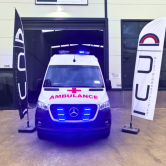
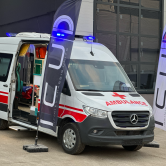
As an expert in the production of emergency vehicles, ICU Automotive has been manufacturing Mercedes ambulances under its own brand for some years. “We want to differentiate ourselves from standard producers by referring to the philosophy, quality standards, and top-level design that distinguish emergency ambulance vehicles,” explains Moreno Pollio, Brand and Communication Specialist at ICU Automotive. “By changing the design of the rear door, we have given the vehicles an elegant and original look that further enhances some of the characteristics that distinguish this exclusive segment of the automotive market.” The vast experience of a manufacturer specializing in the production of ambulances translates into practical advice aimed at improving both the comfort and safety of the crew transporting the patients, thus increasing the efficiency of the emergency, health, and rescue activities.
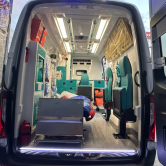
The vehicles produced by ICU Automotive for conveying patients in serious emergency conditions are the result of a set of important design choices, based on valuable insights directly provided by professionals in the field, in addition to studying the specific needs of healthcare facilities. “At the design stage, we invite the workers and managers of the structures involved in their production and use to attend our advisory boards, so that the proposed modification solutions make using this vehicle more effective.” Some examples? “We have produced Elena with huge refrigeration units, fitted a real operating room, and designed a complex air suspension system to ensure high and stable travel comfort, even with a high number of surgeries.” It should also be mentioned that these Mercedes ambulances have developed a negative pressure system for the prevention of infections from communicable diseases for both staff and patients.
3.1. Company Overview
ICU Automotive is a manufacturing sector company with a strong footprint in the field of medical products and ambulances in both domestic and worldwide markets. We are one of the key manufacturers of medical equipment and state-of-the-art setups. We are delivering our services in the manufacturing of the product, aiming to create a positive impact by leveraging our healthcare industry during emergent times and serving customer segments such as companies, hospitals, central medical research institutions, and central labs. The company was established in 2018 in Bengaluru, Karnataka. ICU Automotive is complementary to vehicle manufacturers and can be a potential collaboration partner in the manufacturing sector. We deliver safety features that protect passengers against machines and address the need for safety among ambulances. We manufacture customized ambulances. In the financial year 2018-19, our first year, we manufactured and sold fifteen hundred ambulances. ICU Automotive values customer satisfaction the most and operates best with a continuous feedback loop for customers. Our history simply implies the ambition our visionary leaders had. The milestones speak volumes about our growth and the standards we have set in the industry. ICU and its state-of-the-art capabilities couldn’t have been made without the continuous partnerships. The ambitious project investment of ICU Automotive caught the eyes of talented and qualified industrialists, who will soon become co-founders of the company. ICU’s partnership is continuous.
4. Design and Features of Mercedes Ambulances
Mercedes ambulances are uniquely designed with both aesthetics and functionality in mind. Indeed, Mercedes emphasizes that designing an ambulance is more difficult compared to other vehicles. This is because an ambulance needs to fully reflect the distinction between a working tool and transporting patients in distress. As an ambulance functions as a hospital on wheels, the design of the ambulance must take into consideration, first, the medical staff who accompany it, because they have to verify that the patient is still alive, and second, the needs and comfort of emergency patients who are being transported.
Medical-technical planners are also part of the design team. They ensure that the patient transport compartment meets the requirements of both the medical staff and the patients. Mercedes ensures the provision of the latest technology that makes emergency medical transport safer and more efficient. The medical compartment is designed in such a way that it can carry medical equipment, and everything is placed in an ergonomic position. Mercedes also designs ambulances to have good maneuverability, a lightweight, and a durable chassis. Therefore, it has been proven that Mercedes ambulances are capable of carrying heavy loads while at the same time can be maneuvered easily through city streets as well as on rough terrain.
Due to the complex nature of healthcare services, Mercedes, in collaboration with relevant stakeholders, presents a variety of ambulances that can be used in various health facilities, such as general hospital ambulances, EMS ambulances, rural health center ambulances, public health center ambulances, and micro or village hospital ambulances. Mercedes also presents a variety of customization options, including patient transport vehicles with single stretcher, double stretcher, automatic sliding door, and manual sliding door. Mercedes also provides other configurations in multislice, complete ambulance, BLS vehicle, first response, and neonatal ambulances. The ambulance delivery may be specifically equipped but combined into off-road or air-conditioned versions. This clearly illustrates the essence of design. It is not just about innovation, but how to improve emergency healthcare delivery.
4.1. Medical Equipment and Technology Integration
Medical Equipment and Technology Integration: The sedation modes possibly being utilized to soothe patients during transportation are monitored by the built-in SedLine and Entropy Brain Function Monitoring System. Mercedes also offers a blue light to illuminate the medical workspace without leading to the patient experiencing eye discomfort or waking them up. Mercedes-Tech ambulances integrate the Automatic Transport Monitoring System. In addition to these systems, enhancements are being developed to create better communication channels and real-time interaction between ambulances in the field and partnering hospital ER staff without the use of radio assistance, as well as between the ambulance and its patients.
Cutting-edge emergency medicine practices on the road aim to stabilize a patient in critical condition as soon as possible and begin life-saving or life-sustaining treatment even if they are not yet in the hospital’s ER. The idea is to detain morbidity, and for that, ambulances are incorporating increasingly more technology and turning them into a pre-ambulatory emergency unit rather than simply transportation. However, it is a major challenge to integrate all equipment because it is expensive, continuously improved technologically, and complex to maintain by EMS providers. These ambulances are equipped with much of the healthcare status monitoring equipment needed for a hospital ER. Threats mean that these vehicle emergency medical systems are also closed and almost invisible to the world beyond. In the eyes of the EMS industry, a set of advanced communication techniques and similar lifesaving equipment and software, which also require ongoing training, are available to provide ambulance-based healthcare workers with skills such as hemostatic powder application, and are available in prehospital trauma care. It may seem “more science fiction than complete technology in the present.” As more powerful communication and technology systems develop and become accessible, both pre-hospital and hospital systems in developed countries have started to coordinate so that incoming critical care patients can begin treatment seconds after they arrive in the ambulance. In the future, it is hoped that an increasing number of these systems and transmission lines will become accessible from inside and outside the ER. Some physicians, however, are concerned that in some cases the technology might make the physiological observations of the badly wounded less effective or accessible to ambulance medical staff and ER physicians because the latter are still given the ultimate responsibility for the patient’s condition in the emergency. All this offers care personnel not only an opportunity to prepare for the expected but also to treat patients in real-time before they enter the emergency department, which has been described as “a real advance.”
5. Case Studies and Real-World Applications
Case Studies / Real-World Applications Buir, Lehrte, Wunstorf, and Laatzen-Grasdorf fire services, Germany For seven years now, four fire services in the Hanover region of Germany have been using Mercedes diesel ambulances with oxygen, plus medical equipment, to celebrate New Year’s Eve. This service has saved approximately off the cost of the emergency doctors who would otherwise have had to be available to attend emergencies. They are well satisfied with their selection of large engine Mercedes Sprinters and have never had to turn the engine off. Birmingham Ambulance Service, United Kingdom Birmingham Ambulance Service has both very old and new, large engine Sprinter ambulances responding to emergency calls annually. They have an excellent equipment demonstrator center and they fully update their ambulances or build an ambulance to order following the bi-annual specifications. Fire-Rescue Main-Taunus, Germany The team at Hattersheim is pleased with their diesel Mercedes-Benz “Ambulanz-Pkw.” For example, they used it to transport travelers with respiratory problems to hospitals during the war. Ottawa County, USA This rural county has always used a different manufacturer of trucks and automobiles; their diesel turbo engine Mercedes “vanbulances” are now carrying half the medical supplies because the equipment is so reliable and allows more room for the patient. NEAS, Australia The local Mercedes-Benz Dealer at Hornsby Village Sprinter Centre visits the Northern Sydney Ambulance station regularly. He provides courses to the local small and large bike paramedics who can study the sophisticated medical equipment present on a Sprinter, so when it arrives at a scene, they know what is there. His team is all very proud of the health care they provide. RF Drive Paramedic Team, Düsseldorf, Germany Dr. R. Lutz provides a very personal service in an extra-long diesel engine Sprinter; he also assists musicians at various concerts and aquatic sports pools. Smith Ambulance Hollywood, USA The doctors and maintenance crew attend to seven European ambulances based at their company headquarters. As Smith Hollywood was the world’s leading supplier of ambulances, they continued to support some of the equipment left over in ambulances. E-911, Cole County, USA Four Terry Ambulance County teams based in the City of Loeshire are responsible for the activities of sprinters which attended German ambulance service technicians during their visit last week. St. John Ambulance, United Kingdom This pharmaceutical company manufactures a product that assists with the deterioration from thrombolysis and will call for a doctor, a pharmacist, and a paramedic to discuss the latest ambulance. Alltel Ambulance Team “Real World Experience” is the patient feedback from snow-borne patients calling for assistance at winter conclaves such as the SnowDome or the Alps. They were very relieved to see a Braun Mercedes being driven to them by our drivers. They also knew we’d spent time obtaining permission from the venues to demand extra firepower from within the Mercedes sport ambulance to assist them outside the areas. They recognized us in our three-year-old Mercedes ambulance, which we upgraded. They’ll be watching Liquid Ambulances at work this year. The St. John team is relieved by this total, which makes us feel much more confident. We also know people are looking out and caring for us as the service has evolved from older, less sophisticated donors. Sue, a Sydney-based SnowDome customer, was treated last year.
5.1. Success Stories in Healthcare Systems
Possibly the most recognizable story about the impact of ambulances occurred in Queensland, Australia, in 1996. There, the introduction of Sprinter ambulances led to changes in patient survival rates. A two-minute improvement in the ambulance service on-road time to patients experiencing a heart attack led to a 12-13% increase in survival rates. This, and other stories, particularly those from the United States of America, have been influential in changing first responder vehicle types from being provided to ambulances first and then to general rescue, to being provided to fire services, patient transport services, and ambulances across jurisdictions.
In Harrisburg, Pennsylvania, the local ambulance service discovered the value of investing in beautiful, high-performance dedicated vehicle technology. The ambulance service realized that integration between first responder ambulance services and hospitals saved lives. Rabbi Goldstein was taken to the hospital in a Sprinter ambulance. Rabbi Goldstein survived. Father Golamari was also saved. There are many stories such as this that come back to the final step of the health and medical care system, the system that performs the function of emergency medicine and the transportation of patients between home and the health and hospital environment. This is a system that, around the world, has developed dedicated vehicles – high-profile, recognizable vehicles that are absolutely proven to save lives. An Australian woman wrote and said: ‘Your proposal is a welcome one to return accountability to the most important sector of healthcare. My husband was a PA for several years in an area of the western suburbs close to indoor market gardens. The ambulance officers in that area knew that in the event of a stroke or MI, they had to assess and transport very quickly to avoid brain tissue or heart muscle damage.’