


Mercedes-Benz Sprinter Ambulance: The Gold Standard in Mobile Medical Response
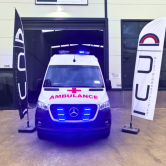
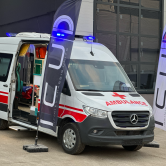
Mercedes-Benz Sprinter Ambulance; The Mercedes-Benz Sprinter is more than just a van; it’s the world’s premier platform for ambulance conversion. Renowned for its reliability, safety, and versatility, the Sprinter forms the backbone of emergency medical services (EMS), non-emergency patient transport, and critical care units across the globe. Its design provides an unparalleled blend of robust engineering and a refined base for life-saving equipment.
Why the Sprinter is the Preferred Choice
- Unmatched Reliability: Sprinter ambulances are built for high-stress, high-mileage duty cycles. Their powerful and efficient diesel engines (like the OM 651 4-cylinder or V6 options) are designed for relentless performance, ensuring that responders can depend on their vehicle in any situation.
- Superior Safety: Mercedes-Benz’s commitment to safety is deeply embedded in the Sprinter. It comes equipped with a comprehensive suite of advanced safety features, including:
- ADAPTIVE ESP®: Electronic Stability Program that includes Crosswind Assist, Load Adaptive Control, and Brake Assist.
- Active Brake Assist: Can help prevent frontal collisions.
- Attention Assist: Detects drowsy driving patterns.
- A robust chassis with a rigid safety cell and front/rear crumple zones.
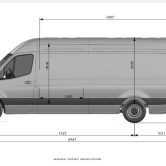
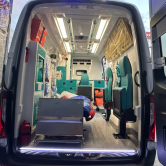
- Exceptional Space and Interior Design: The Sprinter’s high-roof, long-wheelbase configurations offer immense interior space. This allows for:
- Efficient Workflow: Ample room for EMTs to move around and provide critical care to a patient during transport.
- Extensive Equipment Storage: Customizable cabinets and mounting systems to securely store ventilators, monitors, defibrillators, medications, and oxygen systems.
- Patient Comfort: A less confined feeling for patients, which can be crucial in reducing anxiety.
- Power Management: Ambulance conversions feature a sophisticated dual-battery system with an inverter. This ensures that all critical medical equipment has a reliable 12V and 110V/230V power source without the risk of draining the vehicle’s starter battery.
Key Variants and Configurations
The Sprinter platform is highly flexible, leading to several types of ambulance configurations:
- Type II Ambulance: Typically built on a van chassis (not cutaway). The modular ambulance body is integrated directly into the van’s original structure. Sprinter’s high roof makes it an excellent candidate for this type, which is common for hospital-based transport and 911 response.
- Type III Ambulance: Built on a cutaway van chassis. The modular ambulance body is attached to the chassis, with a pass-through connection (“doorway”) between the cab and the patient module. This design is hugely popular in North America and leverages the Sprinter’s chassis strength for a larger patient compartment.
- Specialized Units:
- Critical Care Transport (CCT): These “Mobile ICUs” are outfitted with more advanced equipment for transporting critically ill patients between facilities. The Sprinter’s smooth ride quality and space are essential for this role.
- Non-Emergency Medical Transport (NEMT): Configured for comfort and capacity, often with multiple patient seating for routine medical appointments.
Technical Highlights of a Typical Sprinter Ambulance
- Powertrain: Common engines include a 2.1L turbo diesel I4 or a powerful 3.0L V6 turbo diesel, often paired with a smooth 7G-TRONIC PLUS automatic transmission or the latest 9-speed automatic. Rear-wheel drive is standard, with 4×4 available for all-weather capability.
- Chassis: A high-load-capacity chassis designed to handle the significant added weight of the medical module, equipment, and personnel without compromising performance or safety.
- Lighting and Electrical: Integrated LED emergency lighting (lightbars, scene lights, side warning lights), a powerful electrical system with isolation modules, and often an onboard generator or inverter system.
- Climate Control: A separate, powerful rear heating and air conditioning system is mandatory to maintain a controlled environment for the patient and crew, independent of the front cab’s climate settings.
The Conversion Process
Mercedes-Benz produces the base vehicle, which is then sent to a qualified upfitter (or converter). These specialized companies transform the empty van into a fully-equipped ambulance. This process involves:
- Installing the interior cabinetry and work surfaces.
- Adding the electrical and oxygen systems.
- Reinforcing the body and installing warning systems.
- Applying exterior graphics and finishes.
Conclusion: The Ultimate Mobile Tool for First Responders
The Mercedes-Benz Sprinter Ambulance is not merely a vehicle; it is a vital piece of medical infrastructure. Its winning combination of German engineering, unwavering durability, and exceptional safety provides EMS professionals with the confidence and capability they need to perform their life-saving work. From its spacious and customizable interior to its advanced driver-assistance systems, the Sprinter continues to set the benchmark for what a modern ambulance should be, ensuring that medical crews and their patients are in the best possible hands from the moment a call comes in.
11 Comments
melhor código de indicac~ao binance
September 2, 2026Thanks for sharing. I read many of your blog posts, cool, your blog is very good.
binance
September 3, 2026I don’t think the title of your article matches the content lol. Just kidding, mainly because I had some doubts after reading the article.
binance h"anvisningsbonus
September 3, 2026Can you be more specific about the content of your article? After reading it, I still have some doubts. Hope you can help me. https://www.binance.bh/ar/register?ref=PORL8W0Z
Skapa personligt konto
September 4, 2026Thank you for your sharing. I am worried that I lack creative ideas. It is your article that makes me full of hope. Thank you. But, I have a question, can you help me?
skapa binance-konto
September 5, 2026Your article helped me a lot, is there any more related content? Thanks! https://accounts.binance.com/register/person?ref=IXBIAFVY
conta gratuita na binance
September 5, 2026Can you be more specific about the content of your article? After reading it, I still have some doubts. Hope you can help me. https://www.binance.bh/register?ref=IXBIAFVY
binance prihlásení
September 6, 2026Thanks for sharing. I read many of your blog posts, cool, your blog is very good.
打开Binance账户
September 6, 2026Can you be more specific about the content of your article? After reading it, I still have some doubts. Hope you can help me.
binance Registrera dig
September 7, 2026I don’t think the title of your article matches the content lol. Just kidding, mainly because I had some doubts after reading the article.
binance Registrera
September 9, 2026Thank you for your sharing. I am worried that I lack creative ideas. It is your article that makes me full of hope. Thank you. But, I have a question, can you help me? https://www.binance.bh/register?ref=IHJUI7TF
skapa binance-konto
September 14, 2026Your point of view caught my eye and was very interesting. Thanks. I have a question for you. https://accounts.binance.info/register/person?ref=IHJUI7TF